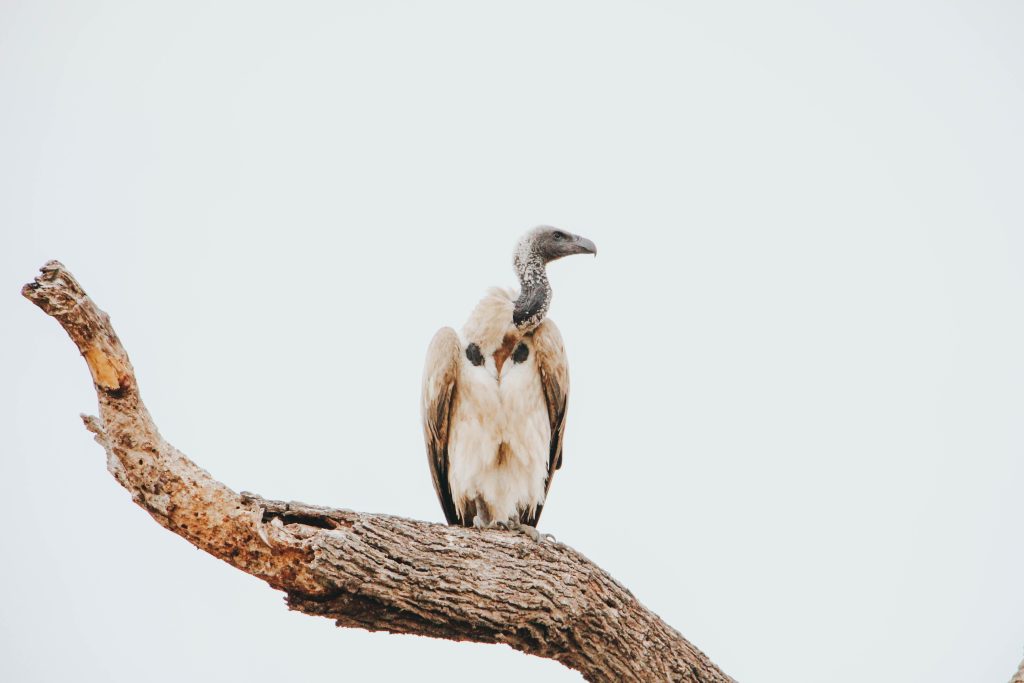
The Silent Sky-Keeper: A Portrait of Solitude and Survival
Set against a canvas of endless, muted white sky, this image strips away all distraction to present one of nature’s most heavily misunderstood creatures. Resting on a gnarled, deeply textured branch of dead wood, a vulture surveys its kingdom in absolute stillness. There is an undeniable gravity to this scene—a quiet, ancient dignity that demands our attention.
The Beauty of the Unloved
Take a closer look at the details. While we often think of vultures as scruffy, this individual carries itself with a stoic elegance. Its dark, heavily speckled grey neck transitions beautifully into a pristine, pale cream ruff of feathers that puffs out like a royal collar. The folded wings, bearing subtle patches of dark chocolate and tan, are neatly tucked in, waiting. The hooked, powerful beak, designed with brutal evolutionary purpose, sits at rest—giving the bird a patient, almost philosophical gaze into the vast emptiness before it.
Nature’s Essential Sanitation Crew
There is a reason these birds have been revered in ancient cultures and are essential to the ecosystems they inhabit. They are the ultimate recyclers, nature’s sanitation department. Without vultures, carcasses would sit for weeks on the African savannahs and Asian plains, festering with anthrax, botulism, and other deadly pathogens. By feeding on dead animals with incredibly acidic stomachs that destroy even the most dangerous bacteria, they don’t just survive—they protect the lives of other animals, and humans, by halting the spread of disease.
A Stark Warning in the Sky
This beautiful, minimalist image carries a haunting undercurrent, especially when you consider the white, cloudless sky. It acts as a stark reminder of the fragility of these creatures. Across Africa and South Asia, vulture populations have crashed by over 95% in recent decades, primarily due to veterinary drugs like diclofenac that are lethal to them. When we lose the vultures, entire ecosystems begin to unravel, leading to feral dog explosions, rabies outbreaks, and widespread ecological imbalance.
The Quietest Observer
While eagles and hawks draw our eyes with dramatic dives, and songbirds fill our ears with melodies, the vulture does its work in terrifying silence. Sitting upon its rugged, weathered perch, it does not demand our admiration; it simply waits. It knows that the circle of life is made up of beginnings and endings, and its role is to see that those endings are cleaned up with brutal efficiency.
This photograph captures a moment of perfect tranquility, but it is also a call to look closer. The next time you see a vulture against a pale sky, don’t look away. Look at a survivor, an eco-warrior, and an unyielding, steadfast guardian of the wild.